We use cookies to enhance the usability of our website. If you continue, we'll assume that you are happy to receive all cookies. More information. Don't show this again.
HSPB1
HPA
RESOURCES
  • TISSUE
  • BRAIN
  • SINGLE CELL
  • SUBCELLULAR
  • CANCER
  • BLOOD
  • CELL LINE
  • STRUCTURE
  • INTERACTION
ABOUT
  • INTRODUCTION
  • HISTORY
  • ORGANIZATION
  • PUBLICATIONS
  • ACKNOWLEDGMENTS
  • CONTACT
NEWS
  • NEWS ARTICLES
  • PRESS ROOM
LEARN
  • DICTIONARY
  • PROTEIN CLASSES
  • PROTEIN EVIDENCE
  • METHODS
  • EDUCATIONAL VIDEOS
DATA
  • DOWNLOADABLE DATA
  • PUBLICATION DATA
  • RELEASE HISTORY
HELP
  • HELP & FAQ
  • ANTIBODY AVAILABILITY
  • DISCLAIMER
  • PRIVACY STATEMENT
  • LICENCE & CITATION
Fields »
Search result

Field
Term
Gene name
Class
Subclass
Category
Keyword
Chromosome
External id
Tissue
Cell type
Expression
Antibody panel
Tissue
Main location
Patient ID
Annotation
Tissue
Category
Tau score
Cluster
Reliability
Brain region
Category
Tau score
Brain region
Category
Tau score
Brain region
Category
Tau score
Cluster
Reliability
Tissue
Cell type
Enrichment
Cell type
Category
Tau score
Cell type group
Category
Tau score
Cell type
Category
Tau score
Cell type
Category
Tau score
Cell lineage
Category
Tau score
Cluster
Cluster
Location
Searches
Location
Cell line
Class
Type
Phase
Reliability
Cancer
Prognosis
Cancer
Category
Cancer
Category
Tau score
Cluster
Variants
Interacting gene (ensg_id)
Type
Number of interactions
Pathway
ipTM
Category
Category
Category
Category
Validation
Validation
Validation
Validation
Antibodies
Data type
Column


  • SUMMARY

  • TISSUE

  • BRAIN

  • SINGLE CELL

  • SUBCELL

  • CANCER

  • BLOOD

  • CELL LINE

  • STRUCTURE

  • INTERACTION

  • HSPB1
BLOOD PAN-DISEASE HT PAN-DISEASE SOMA AGE, SEX, BMI MASS SPECTROMETRY LONG. - CHILDHOOD LONG. - WELLNESS
Human blood

Blood methods
GENERAL INFORMATIONi

General description of the gene and the encoded protein(s) using information from HGNC and Ensembl, as well as predictions made by the Human Protein Atlas project.

Gene namei

Official gene symbol, which is typically a short form of the gene name, according to HGNC.

HSPB1
Gene descriptioni

Full gene name according to HGNC.

Heat shock protein family B (small) member 1
Predicted locationi

All transcripts of all genes have been analyzed regarding the location(s) of corresponding protein based on prediction methods for signal peptides and transmembrane regions.

  • Genes with at least one transcript predicted to encode a secreted protein, according to prediction methods or to UniProt location data, have been further annotated and classified with the aim to determine if the corresponding protein(s) are secreted or actually retained in intracellular locations or membrane-attached.
  • Remaining genes, with no transcript predicted to encode a secreted protein, will be assigned the prediction-based location(s).

The annotated location overrules the predicted location, so that a gene encoding a predicted secreted protein that has been annotated as intracellular will have intracellular as the final location.

Intracellular
HUMAN PROTEIN ATLAS INFORMATION
Upregulated in disease (PEA)i

A gene is classified as upregulated in a disease if the average concentration of all samples of that disease is significantly higher (adj P-value<0.005 and NPX difference>=1) than the average concentration of samples of all diseases as measured by PEA . For gender specific diseases the analysis includes only samples corresponding to the same gender from the other diseases.

Not analyzed
Blood-based immunoassayi

The blood-based immunoassay category applies to actively secreted proteins and is based on plasma or serum protein concentrations established with enzyme-linked immunosorbent assays, compiled from a literature search. The categories include: detected and not detected, where detection refers to a concentration found in the literature search.

Not analysed since only proteins predicted to be actively secreted to blood is analysed here
Mass spectrometryi

Detection or not of the gene in blood, based on spectral count estimations from a publicly available mass spectrometry-based plasma proteomics dataset obtained from the PeptideAtlas.

Read more
Detected
Proximity extension assayi

Indicates whether the protein has been measured (Data available) or not (Not available) using the Olink Explore HT proximity extension assay platform.

Read more
Data available
SomaScani

Indicates whether the protein has been measured (Data available) or not (Not available) using the SomaScan 11K platform.

Read more
Data available
ASSAYS
Pan-disease (Olink HT)
Pan-disease (SomaScan)
Age, Sex, BMI
Mass spectrometry
Age


Longitudinal childhood
Visit


Longitudinal wellness
PAN-DISEASE EXTENDED BLOOD PROTEIN PROFILES (OLINK HT)i

Blood protein levels across diseases and healthy individuals, profiled using the proximity extension assay (PEA) with the Olink Explore HT.

Olink HT (OID45144)

All
Male
Female
2450 samples across 32 cohorts.
0% below LOD.
1069 male samples across 27 cohorts.
0% below LOD.
1372 female samples across 30 cohorts.
0% below LOD.
Class
Median
Alphabetical


Show points
Hide points
PAN-DISEASE BLOOD PROTEIN PROFILES (SOMASCAN)i

Blood protein levels across diseases and healthy individuals, profiled using SomaScan.

SOMAmer (11103-24)

All
Male
Female
2356 samples across 32 cohorts.
0% below LOD.
1020 male samples across 27 cohorts.
0% below LOD.
1328 female samples across 30 cohorts.
0% below LOD.
Class
Median
Alphabetical


Show points
Hide points
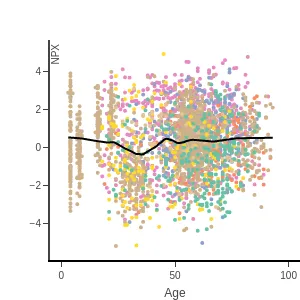
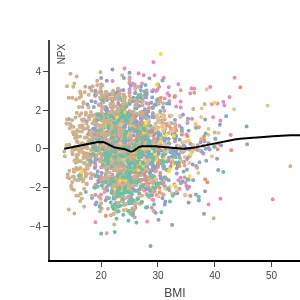
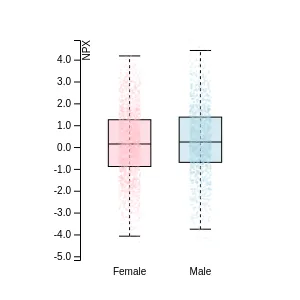
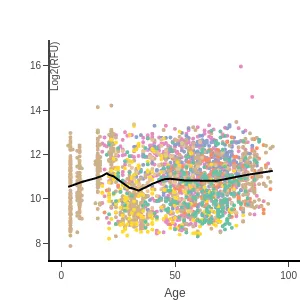
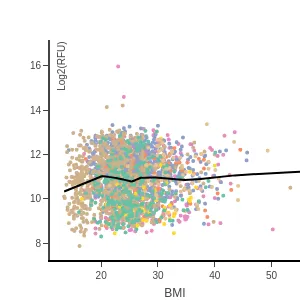
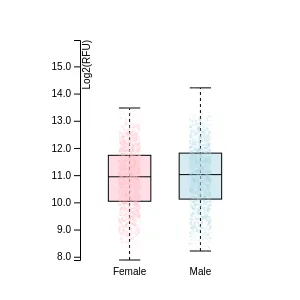
THE EFFECT OF AGE, BMI AND SEX ON BLOOD PROTEIN LEVELSi

Blood protein levels by age, BMI, and sex, measured using the proximity extension assay (PEA) with the Olink Explore 1536. In the age and sex scatterplots, samples are colored by disease class.

Olink HT (OID45144)
SOMAmer (11103-24)
THE BLOOD PROTEIN CONCENTRATION ACCORDING TO MASS SPECTROMETRYi

The protein concentration in blood is quantified by mass spectrometry-based plasma proteomics and estimated from spectral counts in a publicly available data set obtained from the PeptideAtlas.

Detected in plasma by mass spectrometry
25 µg/L, PeptideAtlas
LONGITUDINAL ANALYSIS OF BLOOD PROTEIN LEVELS AT AGES 4, 8, 16 AND 24i

Longitudinal blood protein levels in healthy individuals measured at ages 4, 8, 16, and 24 years, shown separately for males and females. Relative protein abundances were quantified using the proximity extension assay (PEA) with the Olink Explore HT.

Olink HT (OID45144)
SOMAmer (11103-24)
All
Above LOD

Age


All
Above LOD

Age


LONGITUDINAL ANALYSIS OF BLOOD PROTEIN LEVELS DURING TWO YEARS AT OVER 50 YEAR IN AGEi

Blood protein levels in 96 healthy adults (aged 50–65) measured at six visits over a two-year period, shown separately for males and females. Relative protein abundances were quantified using the proximity extension assay (PEA) with the Olink Explore HT.

Olink HT (OID45144)
All
Above LOD

Visit


Contact

  • NEWS ARTICLES
  • PRESS ROOM

The Project

  • INTRODUCTION
  • ORGANIZATION
  • PUBLICATIONS

The Human Protein Atlas

  • DOWNLOADABLE DATA
  • LICENCE & CITATION
  • HELP & FAQ
KAW logo The Human Protein Atlas project is funded


by the Knut & Alice Wallenberg Foundation.

Facebook logo X logo Bluesky logo Linkedin logo RSS feed logo contact@proteinatlas.org
GCBR logo Elixir core logo SciLifeLab logo Uppsala university logo KI logo KTH logo