CACNA1C
HPA
RESOURCES
  • TISSUE
  • BRAIN
  • SINGLE CELL
  • IMMUNE CELL
  • SUBCELLULAR
  • CANCER
  • BLOOD
  • CELL LINE
  • STRUCTURE
  • INTERACTION
  • METABOLIC
  • ISOFORM
  • EVOLUTIONARY
ABOUT
  • INTRODUCTION
  • HISTORY
  • ORGANIZATION
  • PUBLICATIONS
  • ACKNOWLEDGMENTS
  • CONTACT
NEWS
  • NEWS ARTICLES
  • PRESS ROOM
LEARN
  • DICTIONARY
  • PROTEIN CLASSES
  • PROTEIN EVIDENCE
  • METHODS
  • AI IMPLEMENTATIONS
  • EDUCATIONAL VIDEOS
DATA
  • DOWNLOADABLE DATA
  • PUBLICATION DATA
  • RELEASE HISTORY
HELP
  • HELP & FAQ
  • ANTIBODY AVAILABILITY
  • DISCLAIMER
  • PRIVACY STATEMENT
  • LICENCE & CITATION
Fields »
Search result

Field
Term
Gene name
Class
Subclass
Category
Keyword
Chromosome
External id
Tissue
Cell type
Expression
Antibody panel
Tissue
Main location
Patient ID
Annotation
Tissue
Category
Tau score
Tissue
Category
Tau score
Tissue
Category
Tau score
Cluster
Reliability
Region
Niche
Category
Brain region
Category
Tau score
Brain domain
Category
Tau score
Cell type
Category
Tau score
Cell type
Category
Tau score
Brain region
Category
Tau score
Brain region
Category
Tau score
Brain region
Category
Tau score
Brain region
Category
Tau score
Cluster
Reliability
Cell type
Category
Tau score
Cell type group
Category
Tau score
Single cell
Category
Tau score
Single cell
Category
Tau score
Annotation
Annotation
Annotation
Tissue
Cell type
Enrichment
Cluster
Cell type
Category
Tau score
Cell lineage
Category
Tau score
Cluster
Location
Searches
Location
Cell line
Class
Type
Phase
Reliability
Cancer
Prognosis
Cancer
Regulation
Cancer
Regulation
Cancer
Category
Cancer
Category
Tau score
Correlation
Correlation
Cancer
Category
Tau score
Cluster
Variants
Source
PTM
ipTM
Interacting gene (ensg_id)
Type
Number of interactions
Type
Heterodimer
Subsystem
Isoforms
Specificity
Expression
Species
Ortholog
Type
Species
Tissue
Category
Species
Tau score
Data
Category
Data
Species
Category
Category
Category
Category
Category
Validation
Validation
Validation
Validation
Antibodies
Data type
Column


BETA
  • SUMMARY

  • TISSUE

  • BRAIN

  • SINGLE CELL

  • IMMUNE

  • SUBCELL

  • CANCER

  • BLOOD

  • CELL LINE

  • STRUCTURE

  • INTERACTION

  • METABOLIC

  • ISOFORM

  • EVOLUTION

  • CACNA1C
PROTEIN SUMMARY GENE INFORMATION RNA DATA ANTIBODY DATA
Hippocampal formation Amygdala Basal ganglia Midbrain Spinal cord Cerebral cortex Cerebellum Hypothalamus Choroid plexus Retina Thyroid gland Parathyroid gland Adrenal gland Pituitary gland Lung Salivary gland Esophagus Tongue Stomach Duodenum Rectum Small intestine Colon Liver Gallbladder Pancreas Kidney Urinary bladder Testis Epididymis Prostate Seminal vesicle Vagina Breast Cervix Endometrium Fallopian tube Ovary Placenta Blood vessel Heart muscle Skeletal muscle Smooth muscle Adipose tissue Skin Bone marrow Lymph node Tonsil Appendix Spleen Thymus
CACNA1C INFORMATION
Proteini

Full gene name according to HGNC.

Calcium voltage-gated channel subunit alpha1 C
Gene namei

Official gene symbol, which is typically a short form of the gene name, according to HGNC.

CACNA1C (CACH2, CACN2, CACNL1A1, Cav1.2, CCHL1A1, LQT8, TS)
Protein classi

Assigned HPA protein class(es) for the encoded protein(s).

Disease related genes
FDA approved drug targets
Human disease related genes
Metabolic proteins
Transporters
Voltage-gated ion channels
Protein evidence Evidence at protein level (all genes)
Number of transcriptsi

Number of protein-coding transcripts from the gene as defined by Ensembl.

35
Protein interactions Interacting with 1 protein according to consensus
Metabolic subsystems Involved in 1 reaction in 1 subsystem
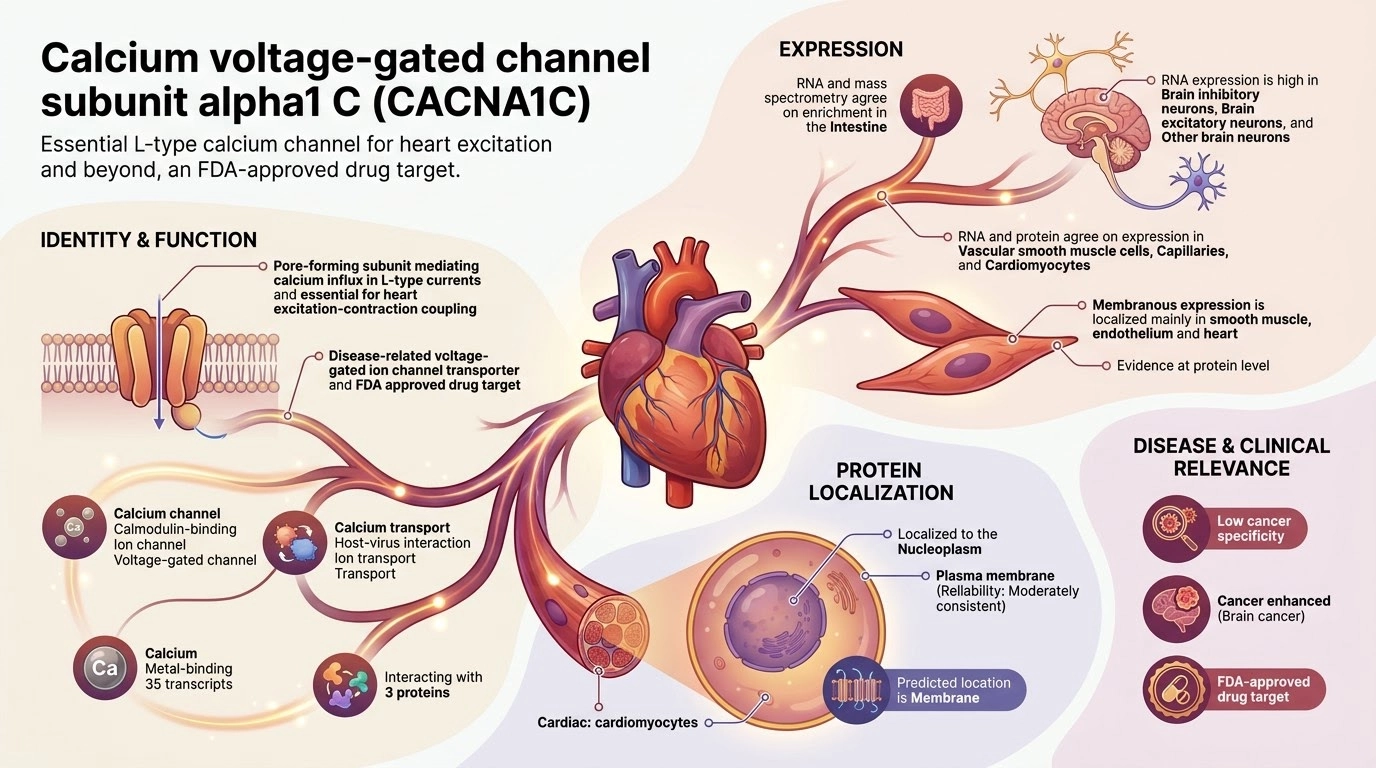
CACNA1C AI GENERATED INFOGRAPHICi

This infographic was generated by AI (Gemini) using only data presented in the Human Protein Atlas v25. It is a quick overview and may contain errors or simplifications, so please check the full data on this gene page before drawing conclusions.

Read more
AI generated infographic for CACNA1C

Disclaimer: This infographic was generated with the help of artificial intelligence, based on data and literature for CACNA1C. It is intended as a simplified visual overview only and may contain errors, omissions or oversimplifications. It has not been individually reviewed by experts and should not be used as a primary source. Please refer to the data presented in the Human Protein Atlas and to the primary literature.

Report an error in this infographic

What seems to be wrong? (select all that apply)
PROTEIN EXPRESSION AND LOCALIZATION
Tissue profilei

A summary of the overall protein expression profile across the analyzed normal tissues based on knowledge-based annotation, presented in the Tissue resource.

"Estimation of protein expression could not be performed. View primary data." is shown for genes where available RNA-seq and gene/protein characterization data in combination with immunohistochemistry data has been evaluated as not sufficient to yield a reliable estimation of the protein expression profile.

Membranous expression mainly in smooth muscle, endothelium and heart.
Tissue specificity (MS) Tissue enriched (Intestine)
Cell type specificity (DVP) Cell type enhanced (Capillaries, Cardiomyocytes)
Subcellular locationi

Main subcellular location based on data generated in the subcellular section of the Human Protein Atlas.

Localized to the Nucleoplasm, Plasma membrane In addition localized to the Primary cilium
Brain cellular locationi

Manually selected location of the protein positivity, observed by immunofluorescence staining in mouse brain.

Soma and synapse in neurons.
Predicted locationi

All transcripts of all genes have been analyzed regarding the location(s) of corresponding protein based on prediction methods for signal peptides and transmembrane regions.

  • Genes with at least one transcript predicted to encode a secreted protein, according to prediction methods or to UniProt location data, have been further annotated and classified with the aim to determine if the corresponding protein(s) are secreted or actually retained in intracellular locations or membrane-attached.
  • Remaining genes, with no transcript predicted to encode a secreted protein, will be assigned the prediction-based location(s).

The annotated location overrules the predicted location, so that a gene encoding a predicted secreted protein that has been annotated as intracellular will have intracellular as the final location.

Membrane
TISSUE RNA EXPRESSION
Tissue specificityi

The RNA specificity category is based on normalized mRNA expression levels in the consensus dataset, calculated from the RNA expression levels in samples from HPA and GTEX. The categories include: tissue enriched, group enriched, tissue enhanced, low tissue specificity and not detected.

Low tissue specificity
Tissue expression clusteri

The RNA data was used to cluster genes according to their expression across tissues. Clusters contain genes that have similar expression patterns, and each cluster has been manually annotated to describe common features in terms of function and specificity.

Smooth muscle tissue - ECM organization (mainly)
Brain specificityi

The regional specificity category is based on mRNA expression levels in the analysed brain samples, grouped into 13 main brain regions and calculated for the three different species. All brain expression profiles are based on data from HPA. The specificity categories include: regionally enriched, group enriched, regionally enhanced, low regional specificity and not detected. The classification rules are the same used for the tissue specificity category

Low domain specificity
Brain expression clusteri

The RNA data was used to cluster genes according to their expression across tissues. Clusters contain genes that have similar expression patterns, and each cluster has been manually annotated to describe common features in terms of function and specificity.

Astrocytes - Astrocyte-neuron interactions (mainly)
Isoform expression categoryi

The expression category reflects the overall expression pattern for the gene based on expression profiles for all individual isoforms.

Read more
Some expressed
Evolutionary conservation categoryi

Conservation category is a categoric annotation that intends to capture the available pairwise species overlap annotations into one metric. The categories range from: Complete, Partial and Minimal Conservation for conserved genes; and Tissue elevation shift, human specific tissue elevated, Non-Human tissue elevated, Human specific detected and Human not detected for non conserved genes.

Partial conservation (Low tissue specificity)
CELL TYPE RNA EXPRESSION
Single cell type specificityi

The RNA specificity category is based on mRNA expression levels in the analyzed cell types based on scRNA-seq data from normal tissues. The categories include: cell type enriched, group enriched, cell type enhanced, low cell type specificity and not detected.

Low cell type specificity
Single cell type
expression clusteri

The RNA data was used to cluster genes according to their expression across single cell types. Clusters contain genes that have similar expression patterns, and each cluster has been manually annotated to describe common features in terms of function and specificity.

Non-specific - Mixed function (mainly)
Bulk RNA deconvolution classificationi

Genes can have enriched specificity in different cell types in one or several tissues, or be enriched in a core cell type that appears in many different tissues.

Cell type enriched (Prostate - Smooth muscle cells, Testis - Early spermatids, Testis - Late spermatids, Thyroid gland - Smooth muscle cells)
Immune cell specificityi

The RNA specificity category is based on mRNA expression levels in the analyzed samples based on data from HPA. The categories include: cell type enriched, group enriched, cell type enhanced, low cell type specificity and not detected.

Not detected in immune cells
Immune cell
expression clusteri

The RNA data was used to cluster genes according to their expression across single cell types. Clusters contain genes that have similar expression patterns, and each cluster has been manually annotated to describe common features in terms of function and specificity.

Not detected - no cluster assigned
CANCER & CELL LINES
Cancer specificity (RNA)i

Specificity of RNA expression (TCGA dataset) across 21 cancer types is categorized as either cancer enriched, group enriched, cancer enhanced, low cancer specificity or not detected.

Low cancer specificity
Cancer specificity (Protein)i

Specificity of protein abundance in tumor samples from 25 cancer types, measured by mass spectrometry (ProteinTalks DB dataset), is categorized as cancer enriched, group enriched, cancer enhanced, low cancer specificity or not detected.

Group enriched (Gastrointestinal stromal tumor, Leiomyosarcoma)
Cell line
expression clusteri

The RNA data was used to cluster genes according to their expression across cell lines. Clusters contain genes that have similar expression patterns, and each cluster has been manually annotated to describe common features in terms of function and specificity.

Lymphoma - Adaptive immune response (mainly)
Cell line specificityi

RNA specificity category based on RNA sequencing data from cancer cell lines in the Human Protein Atlas grouped according to type of cancer. Genes are classified into six different categories (enriched, group enriched, enhanced, low specificity and not detected) according to their RNA expression levels across the panel of cell lines.

Low cancer specificity
PROTEINS IN BLOOD
Detected in blood by
immunoassayi

The blood-based immunoassay category applies to actively secreted proteins and is based on plasma or serum protein concentrations established with enzyme-linked immunosorbent assays, compiled from a literature search. The categories include: detected and not detected, where detection refers to a concentration found in the literature search.

No (not applicable)
Detected in blood by
mass spectrometryi

Detection or not of the gene in blood, based on spectral count estimations from a publicly available mass spectrometry-based plasma proteomics dataset obtained from the PeptideAtlas.

No
Proximity extension assayi

Indicates whether the protein has been measured (Data available) or not (Not available) using the Olink Explore HT proximity extension assay platform.

Data available
SomaScani

Indicates whether the protein has been measured (Data available) or not (Not available) using the SomaScan 11K platform.

Not available
PROTEIN FUNCTION
Protein function (UniProt)i

Useful information about the protein provided by UniProt.

Pore-forming, alpha-1C subunit of the voltage-gated calcium channel that gives rise to L-type calcium currents 1, 2, 3, 4, 5, 6, 7, 8, 9, 10, 11, 12, 13, 14, 15, 16. Mediates influx of calcium ions into the cytoplasm, and thereby triggers calcium release from the sarcoplasm (By similarity). Plays an important role in excitation-contraction coupling in the heart. Required for normal heart development and normal regulation of heart rhythm 17, 18, 19, 20, 21. Required for normal contraction of smooth muscle cells in blood vessels and in the intestine. Essential for normal blood pressure regulation via its role in the contraction of arterial smooth muscle cells 22. Long-lasting (L-type) calcium channels belong to the 'high-voltage activated' (HVA) group (Probable).... show less
Molecular function (UniProt)i

Keywords assigned by UniProt to proteins due to their particular molecular function.

Calcium channel, Calmodulin-binding, Ion channel, Voltage-gated channel
Biological process (UniProt)i

Keywords assigned by UniProt to proteins because they are involved in a particular biological process.

Calcium transport, Host-virus interaction, Ion transport, Transport
Ligand (UniProt)i

Keywords assigned by UniProt to proteins because they bind, are associated with, or whose activity is dependent of some molecule.

Calcium, Metal-binding
Gene summary (Entrez)i

Useful information about the gene from Entrez

This gene encodes an alpha-1 subunit of a voltage-dependent calcium channel. Calcium channels mediate the influx of calcium ions into the cell upon membrane polarization. The alpha-1 subunit consists of 24 transmembrane segments and forms the pore through which ions pass into the cell. The calcium channel consists of a complex of alpha-1, alpha-2/delta, beta, and gamma subunits in a 1:1:1:1 ratio. There are multiple isoforms of each of these proteins, either encoded by different genes or the result of alternative splicing of transcripts. The protein encoded by this gene binds to and is inhibited by dihydropyridine. Alternative splicing results in many transcript variants encoding different proteins. Some of the predicted proteins may not produce functional ion channel subunits. [provided by RefSeq, Oct 2012]... show less

Contact

  • NEWS ARTICLES
  • PRESS ROOM

The Project

  • INTRODUCTION
  • ORGANIZATION
  • PUBLICATIONS

The Human Protein Atlas

  • DOWNLOADABLE DATA
  • LICENCE & CITATION
  • HELP & FAQ
KAW logo The Human Protein Atlas project is funded
by the Knut and Alice Wallenberg Foundation.

Facebook logo X logo Bluesky logo Linkedin logo RSS feed logo contact@proteinatlas.org
GCBR logo Elixir core logo SciLifeLab logo Uppsala university logo KI logo KTH logo
We use cookies to enhance the usability of our website. If you continue, we'll assume that you are happy to receive all cookies. More information. Don't show this again.